You need the state permission to practise and B2 German before you can work as a physiotherapist in Germany.
If your physiotherapy degree is from outside the EU, you need state permission and usually B2 German. We cover steps, documents, time, and costs.
- Physiotherapy
- Recognition
- Anerkennung
- B2
 KI-generiert
You cannot simply start working as a physiotherapist in Germany with a degree from abroad. Physiotherapy is a regulated profession, so you need the state permission to practise (Berufserlaubnis), which you get through the recognition procedure (Anerkennung), and we recommend finishing B2 German before you arrive. Each federal state decides recognition itself, the details differ and can change, and the official state pages are the reference.
What you need:
- completed physiotherapy training or degree
- equivalence check by the authority
- German usually at B2
- health fitness
- reliability and certificate of good conduct
- adaptation course or knowledge test if there are significant differences
Hessen's official page on physiotherapist recognition lists the same basic requirements.
This guide only covers training from outside the EU, the EEA and Switzerland
This guide is for physiotherapy training from outside the EU, the EEA and Switzerland. If your qualification is from the EU, the EEA or Switzerland, other rules apply.
To work as a physiotherapist in Germany, you apply to the competent state authority for permission to use the professional title. Make it in Germany also lists physiotherapist among the medical professions in demand.
The recognition path runs through the state authority
You apply to the state where you want to work, and the authority checks your foreign training against the German physiotherapy training. In Berlin, only the State Office for Health and Social Affairs (LAGeSo) grants the permission.
The authority counts your qualification as equivalent if there are no significant differences. Professional experience or other certified knowledge can offset differences, but you have to prove that. If differences remain, the authority explains them.
Then you usually choose one compensation measure. The adaptation course can last up to three years. The knowledge test has an oral part and a practical part, and the practical part is combined with an interview. When you pass the compensation measure and meet the other requirements, you get permission to use the professional title.
You can start this process from abroad. Berlin says that directly, and Bremen's official page on the same procedure also says you can apply if you do not yet live in Germany. Bremen adds that the application is filed electronically and that you must show the originals in person.
B2 German is the official language level, and Bavaria adds its own specialist language exam
For recognition, the official language level is B2. Berlin's official page on physiotherapist recognition requires B2, and Bremen also names German normally at level B2 of the CEFR. In Berlin, accepted B2 certificates come from the Goethe-Institut, telc, TestDaF or an ECL-certified language school, and the certificate must be no more than three years old.
The B2 certificate does not have to be in the file on day one. In Berlin and Bremen, you can submit the language certificate later and still start the application earlier.
Bavaria adds a separate specialist language exam for physiotherapists. Since 2022, this Bavaria-wide exam has been part of the recognition procedure there. It has three parts of 20 minutes each: a conversation with a patient where you explain technical terms so the patient understands, a conversation between professionals, and a written professional document.
A general B2 certificate and the language of the practice are two different things, and the Bavarian exam tests the second.
Berlin shows which documents, time and costs to expect
Berlin is a good worked example for the file. The documents include the application form, proof that Berlin is responsible for your case, such as an employment confirmation or proof of residence in Berlin, a signed CV, your birth certificate, proof of identity, a German certificate of good conduct not older than three months, good-conduct or good-standing certificates from your home or training country, a medical certificate from a doctor licensed in Germany, and your training documents with a German translation. If you already have your B2 certificate, you add that too, as a certified copy. You need to know which state you are going to before you apply.
If the documents are complete, Berlin gives an approximate processing time of 3 to 4 months. The fee there is €164. Bremen says time and cost vary, and translations, certifications and compensation measures can add costs.
Our recommendation is to finish B2 before you arrive
Our recommendation is to finish B2 before you arrive. If you arrive without it, the language exam sits on top of the country, the practice, the words, the processes and possibly the knowledge test.
In physiotherapy, you explain exercises and listen to symptoms all day. If you only understand part of what a patient says about pain or movement, that has real consequences. With B2 finished, you can put your energy into the work and the recognition instead of into the language.
We recommend that you keep learning after B2, for a life in Germany and not for a certificate, because that is what convinces the best employers and gets you the position you actually want, not just a position.
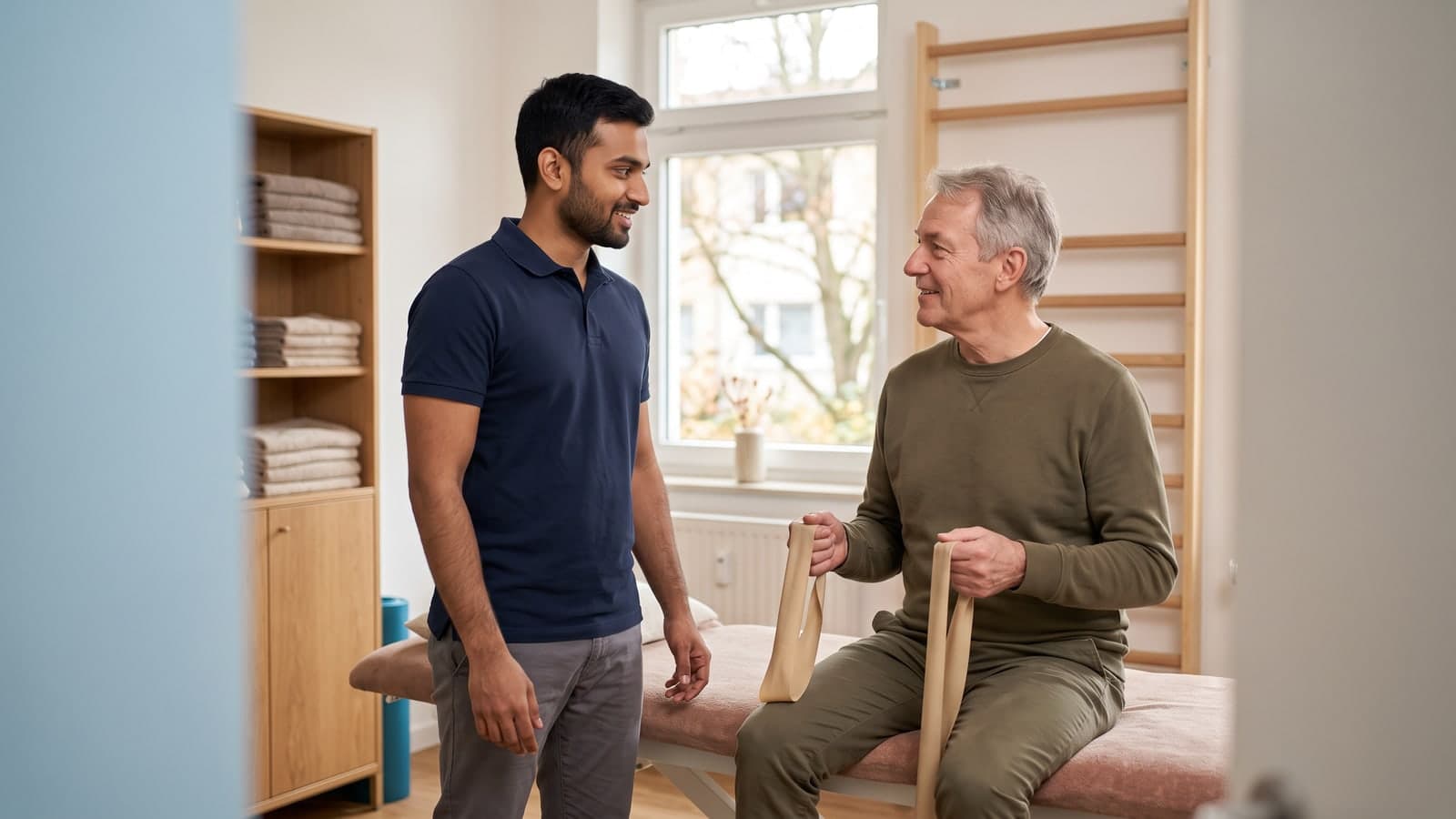
Our physiotherapy course follows Daniel, a physiotherapist from Nigeria, from the job interview and recognition to his first working day in a practice in Munich, then into assessment, case history and specialties such as orthopedics, neurology, geriatrics and pediatrics. You work with words such as „die Anmeldung“ (reception), „die Beschwerden“ (symptoms), „die Beweglichkeit“ (mobility) and „das Theraband“ (resistance band). For the certificate step, our German B2 course includes mock exams in the Goethe format.
If you are not yet qualified and are looking at training in Germany instead, our guide on B1 or B2 for nursing training in Germany covers the language question for trainees.
Before you apply:
- Decide which federal state you are going to and read its official recognition page.
- Prepare your training documents and German translations early.
- Start B2 now and finish it before you arrive.
- If you are going to Bavaria, prepare for the specialist language exam.
- Learn the words of the practice, not only exam German.
Test your exam format
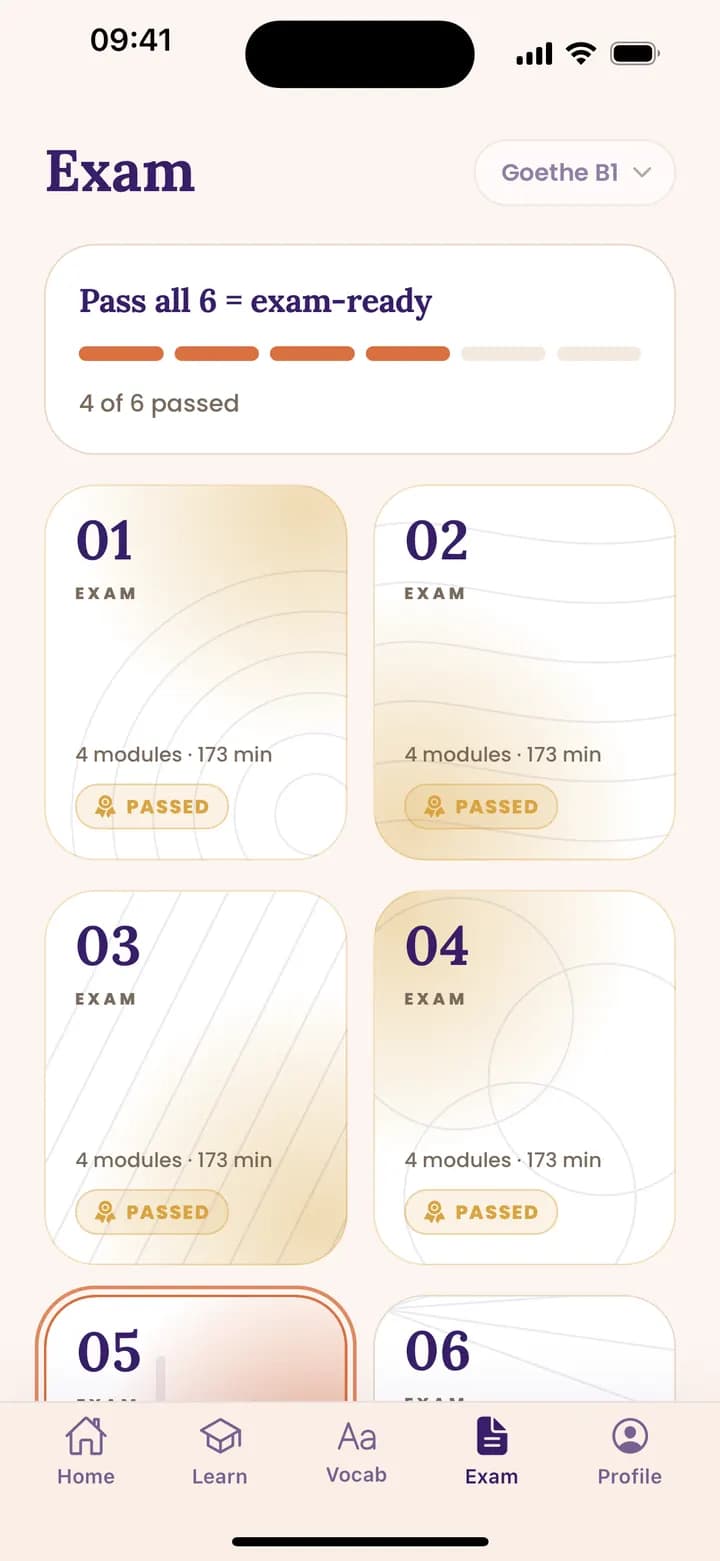
Try full Goethe B1/B2 mock exams, plus writing feedback and speaking practice. Start free and see what you need next.
Get the free appScan to practise in Fluedy
Start free on iPhone or Android.