
Job courseLevel B1
Nursing Training
Your German for nursing training in Germany
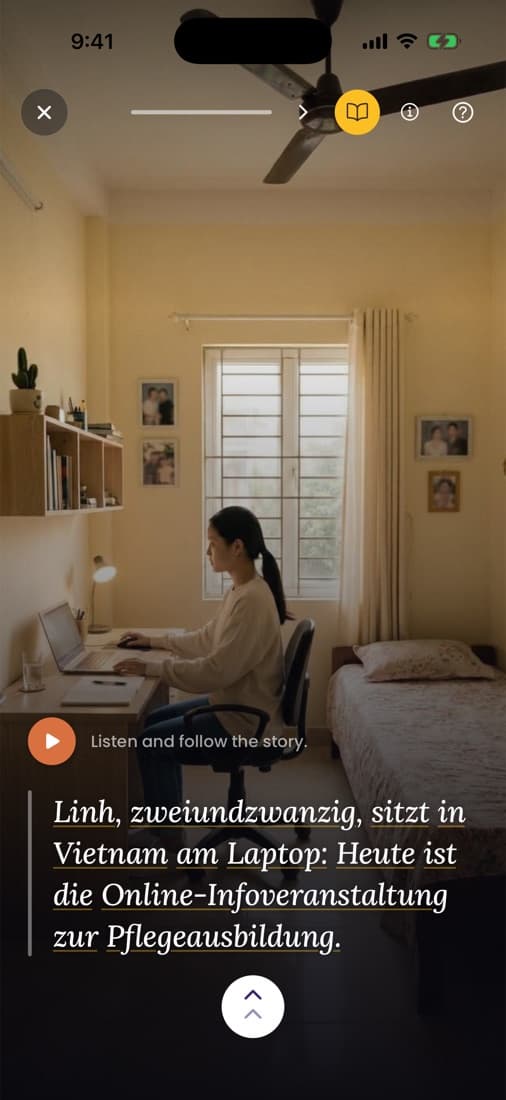
Linh moves from Vietnam to Germany and starts her general nursing training. You follow her from the application all the way to the ward and learn the language for school, the team and patients.


Start free on iPhone and Android

What learners say
Real reviews from the App Store and Google Play.
“Fluedy is a very good app for anyone who wants to learn German. It's especially helpful for nurses and care workers. You can learn the professional language, improve your vocabulary and understand more about the German care system. For people who are new to Germany, the app is a big help. I can really recommend it!”Kanana.
Germany · Aug 2026
“I have been using the app for a while now and I can attest the app comes in handy for all who want to learn the german language,culture and much more about the Germany system. You get a better understanding of how Healthcare systems here work and how to deal with patients and even integrating into the system. To add on it ist easy to use ,straightforward (easy to grasp vocabularies). And you can also set reminders to quickly go through the vocabularies or the units. Totally worth it👌.”Terry Adema
Feb 2026
“The app is very helpful, especially for professionals who need to learn specific German terms! 🤗”Marien B.
Philippines · Feb 2026
Inside the course
You follow Linh's journey in short scenes, listen in and speak the conversations yourself.
The course runs in the Fluedy app.
Frequently asked questions
Is B1 German enough for nursing Ausbildung in Germany?
That depends on the federal state. For nursing training in Germany, the required German level is B1 or B2 depending on where you apply, and for the visa for vocational training you normally need B1. This course is a B1 nursing training course and lets you practise German for situations around starting the Ausbildung.
What German level do I need if I am already a qualified nurse?
If you are already a qualified nurse from abroad, you need at least B2 German for professional recognition. In some cases, a recognition partnership is possible while recognition is still running, and that needs a foreign qualification of at least 2 years, a German work contract, an employer that takes part, and German at A2. This course focuses on language for nursing training, not on recognition.
Is nursing training in Germany paid, and do trainees pay income tax?
Nursing trainees receive a training allowance. Social security contributions are deducted, and income tax usually is not because the allowance is below the basic tax-free amount. This course follows the start of nursing training in Germany, so you practise language for that setting.
What happens in the nursing course?
In this course, you follow Linh from Vietnam as she comes to Germany and starts general nursing training at a hospital and its nursing school. You go with her from the application and the offer through arrival, the start of training and the first ward placement to patients, the team, relatives and the final exams. The story is told in short units where you listen to conversations and speak and practise along.
Which German words for the ward will I learn?
You learn ward words such as das Patientenzimmer (patient room), die Übergabe (handover), die Körperpflege (personal care), der Blutdruck (blood pressure), die Manschette (blood pressure cuff), die Rufanlage (call system), der Waschlappen (washcloth) and die Händedesinfektion (hand disinfection). These words come up in the story and practice of this course.
Does the course prepare me for a German certificate exam?
This course is a language course for nursing training, not an exam course. If you want to practise for a B2 certificate, Fluedy’s German B2 course has mock exams in the Goethe format.
Start today
Download Fluedy and start with the first units.